How Is Education Changing in the Digital Age?
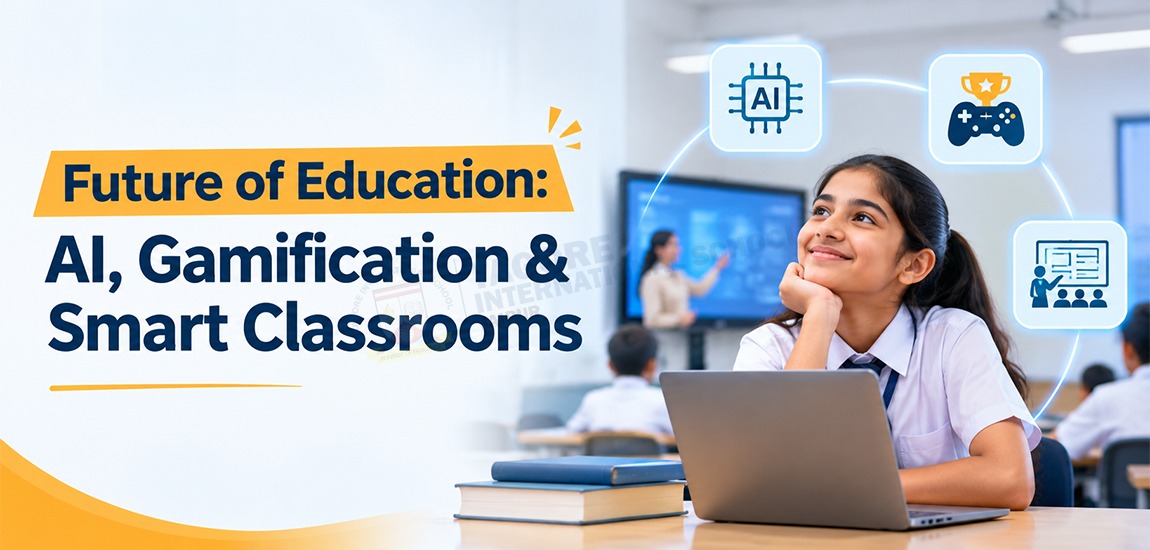
Quick answer: The future of education combines three tools: artificial intelligence that personalises learning, gamification that keeps students engaged, and smart classrooms that make ideas visual. Teachers stay at the centre, using these tools to understand and guide every child better.
Today a student can ask an AI tutor to explain fractions three ways, compete in a live class quiz, and explore a 3D model of the human heart, all in one school day. In India, this shift is now official policy: CBSE has introduced a Computational Thinking and AI curriculum for Classes 3 to 8 from the 2026–27 session.
But a smart board alone does not make a school future-ready. What matters is how technology is used, and whether it builds thinking, honesty and confidence instead of shortcuts.
The Role of AI and Personalised Learning
AI in education means software that studies how a student learns and responds with the right explanation, practice or feedback. It works like a patient tutor available at any time.
Adaptive learning platforms are the clearest example. They follow a simple cycle:
- Diagnose what the student already knows through a short quiz.
- Recommend the next lesson at the right level.
- Adjust difficulty based on each answer.
- Report gaps to the teacher, who steps in with targeted help.
This means fast learners stay challenged, students who need more time get it without pressure, and weak areas are fixed long before board exams.
The golden rule: AI should be a tutor, not a ghostwriter. Asking AI to explain a concept is learning. Asking it to write the whole answer is not.
How Gamification Improves Student Engagement
Gamification adds game elements such as points, levels, badges and challenges to everyday lessons. It works because students get clear goals, quick wins and a reason to try again after a mistake. A 2026 meta-analysis found that well-designed gamification improves learning outcomes.
|
Game element |
In the classroom |
|---|---|
|
Instant scores |
Live quizzes that explain why an answer is wrong |
|
Levels |
Maths or coding tasks that unlock step by step |
|
Badges |
Recognition for skills like teamwork or public speaking |
|
Team leaderboards |
House-wise quiz and activity competitions |
|
Educational games |
Puzzles, simulations and coding challenges |
The key is to reward thinking and teamwork, not just speed, so every student stays motivated, not only the toppers.
What Is a Smart Classroom and How Does It Work?
A smart classroom uses connected digital tools to make lessons interactive and visual. Instead of only reading about tectonic plates, students watch a simulation of plates colliding and mountains forming, then answer a quick poll so the teacher can see who understood.
Common smart classroom tools include:
- Interactive smart boards for diagrams, videos and live problem-solving.
- Digital content such as e-books, quiz apps and government platforms like DIKSHA.
- Virtual labs that let students rehearse science experiments safely before the real lab.
- Connected devices so every student can respond, not just a few.
- 3D models and AR/VR that bring the solar system or the human body to life.
Virtual labs should support real labs, not replace them. Hands-on experiments under a teacher still build the practical skills CBSE assesses.
Benefits of Combining AI, Gamification and Smart Classrooms
Each tool is strongest when used with the others. A smart board introduces the concept, a game reinforces it, AI personalises the follow-up practice, and the teacher checks real understanding.
- Deeper understanding through visual, hands-on lessons.
- Higher engagement because students actively participate.
- Learning at the right pace for every child.
- Early support for students who are falling behind.
- Future-ready skills like digital literacy, problem-solving and teamwork.
Technology supports teachers, it doesn't replace them
AI can explain and grade, but it cannot notice a quiet child who is struggling, resolve a conflict, or inspire a love of learning. CBSE has made AI and computational thinking its teacher training theme for 2026–27, which shows the goal is to empower teachers. With routine work automated, teachers get more time to mentor, guide and build values.
Challenges of Technology-Driven Education
Technology also brings risks that every school must manage carefully.
- Digital access: not every child has equal access to devices and internet at home, so schools need strong on-campus labs and offline options.
- Privacy: India's DPDP Rules, 2025 treat everyone under 18 as a child and require verifiable parental consent for processing their data, with limited exemptions for schools.
- Screen time: too much screen use affects sleep, eyesight and focus, so digital lessons must be balanced with sports, reading and outdoor play.
- Responsible AI use: AI can give wrong or biased answers and make copying easy. UNESCO's guidance recommends protecting student data, checking AI tools before use, and considering an age limit of 13 for independent classroom use.
The best schools set clear rules: students may use AI to understand and practise, but must do the final work themselves and be able to explain it.
The Future of Education: What to Expect
- Students will learn AI literacy early, follow more personalised learning paths, and be assessed through projects and presentations, not just memory.
- Teachers will spend less time on paperwork and more on mentoring, supported by data on each child's progress.
- Schools will treat smart classrooms and digital labs as standard, with clear policies on AI, privacy and screen time.
Conclusion: Technology With a Human Touch
The future of education is not tradition versus technology. It is AI that personalises, games that motivate and smart classrooms that explain, all guided by caring teachers. Students who learn this way are ready not just for exams, but for life.
At Tagore International School, Jaipur, this balance has been part of our approach since 1997. Our CBSE school in Mansarovar combines smart classrooms and modern labs with peer-teaching, flip-teaching, sports and co-curricular activities, so every child grows academically and personally.
Looking for a future-ready CBSE school in Jaipur? Explore admissions at TIS or call 0141-2784649 / +91 72969 62201.
Frequently Asked Questions
1. What is the future of education?
Ans. It is a blend of AI-powered personalised learning, gamified lessons and smart classrooms, guided by teachers, with a focus on thinking skills, creativity and values.
2. What is a smart classroom?
Ans. A classroom that uses interactive boards, digital content, simulations and connected devices to make lessons visual and interactive.
3. Does gamification really help students learn?
Ans. Yes, when it rewards understanding and teamwork. Research shows it raises motivation and engagement and can improve results.
4. Will AI replace teachers?
Ans. No. AI handles routine tasks and practice; teachers provide mentoring, judgement and emotional support.
5. Is CBSE teaching AI in schools?
Ans. Yes. CBSE introduced a Computational Thinking and AI curriculum for Classes 3 to 8 from the 2026–27 session.