Introduction: Beyond Marks — Skills That Matter
Academics play an important role in shaping the future of students. For many years, the focus has been on getting good grades. But today, the need for skill development has been understood and the education system has also evolved to prepare students accordingly. Skills are important for students so they can communicate well, adapt to changes and take decisions.
A student can score well in exams but his future depends largely on how he handles ups and downs of life and utilizes his knowledge. To teach students required skills, schools have started teaching beyond syllabus. They create opportunities and environment where students can learn, experiment, communicate, question, collaborate and grow.
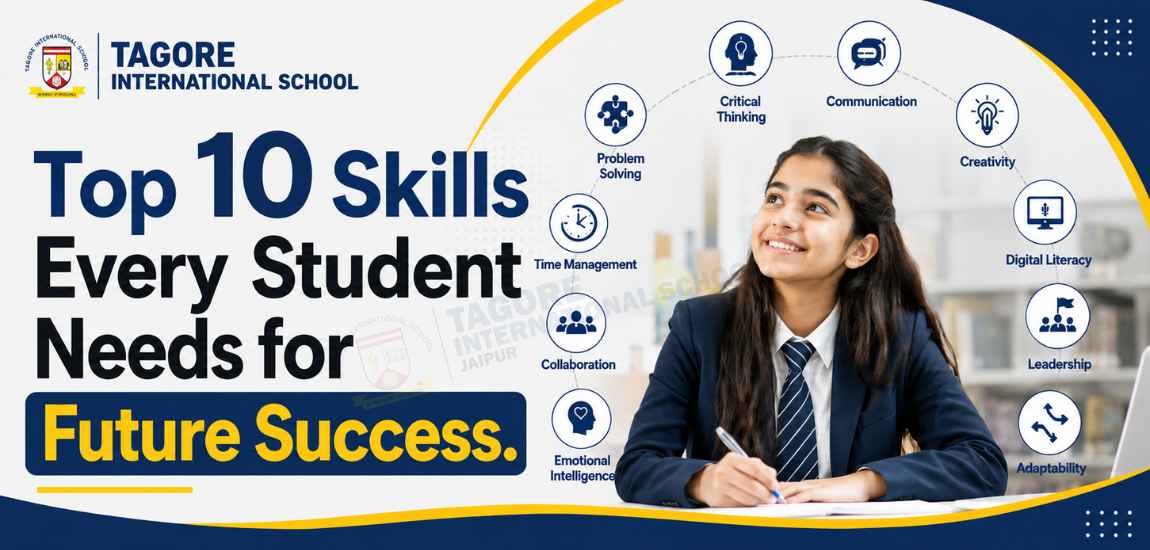
Here are the best 10 skills that every student will need for handling the changing future
1. Critical Thinking and Problem-Solving
Problems are a common part of our lives and students face them everyday both inside and outside the classroom. Therefore, it is necessary that children learn how to tackle them independently. Critical thinking and problem solving are essential life skills which are needed for living a successful life.
While critical thinking helps students is learning how to question the given information and have different perspectives, problem-solving teaches them to understand, find possible solutions and evaluate outcomes for a given problem.
In school, students are encouraged to learn these skills through case studies, experiments, puzzles, projects, and group discussions.
2. Communication and Public Speaking
Communication skills play an important role in determining success. Students should learn how to ask questions, express ideas, listen to others and participate confidently in any conversation. It not only helps them in overcoming fear of speaking their minds but also helps in building self-confidence.
Public speaking skill helps a student in speaking confidently in front of a huge crowd. This skill can be helpful in debate competitions, giving presentations, and group discussions. It provides opportunities to communicate with the audience.
Different activities are conducted in schools like debate competitions, speech competitions, and group discussions to help students learn and become confident in putting forward their point of view.
3. Digital Literacy and Tech Skills
Digital literacy has become important with the increasing use of technology. It is not limited to using a smartphone or browsing internet but relates to the ability of finding reliable information, protecting personal information and effectively communicating using the digital tools.
Depending on the age, students can be given exposure to coding, research tools, multimedia projects, and emerging technologies which can further strengthen their digital learning and capabilities.
In schools, students can be taught technology as a tool for learning and creating something useful. They should learn that it not only for entertainment purpose and hold lot of importance in the present times and coming future.
4. Emotional Intelligence and Self-Management
Man is a social animal and to successfully live in a society, a person must be capable of understanding emotions of oneself and others. He must show empathy and respond to different situations properly. This is only possible when he is emotionally intelligent which means he can understand himself and even others.
Life is full of challenges and student must know how to handle disappointment and failures. Facing every situation in a matured way can help in overcoming obstacles positively. Further, self-management is also important as it teaches how to deal with stress, control impulses and take responsibility of one’s actions.
Schools can help in developing these qualities by encouraging effective communication, reflection, and conducting activities which teach students the skill of handling both success and failure.
You can read also:- Complete Guide to CBSE Admission Process in Jaipur
5. Time Management and Organisation
Time management plays an important role in student life as it helps in balancing academics, activities, examinations, projects and personal commitments. Learning how to manage time effectively can lead to lesser stress levels. There are simple activities which help preparing a time table, breaking large assignments in small steps and prioritising tasks.
In addition to time management, organization also matters as both go hand in hand. If you can manage your time but your organization skills are poor then you are most likely going to waste your time. Time management and good organization skills can help students achieve great things.
In schools, activities are given that are required to be completed withing the given time period. Presentations and programs are conducted which are organized and managed by students to help them learn and grow.
6. Teamwork and Collaboration
No matter in which field students work, whether it is science, medicine, technology, education, or sports, they are likely to meet different types of people. Working with them can be challenging but if you know how work in as a team, you will surely succeed.
Collaborative classroom activities, sports and group projects are very helpful in teaching students how to work together. There are going to be disagreements but when you are dedicated towards achieving a goal, you will eventually find a way.
7. Creativity, Adaptability and Leadership
Creativity is all about creating something new using one’s own imagination and skills. This skill helps in surviving, flourishing and living a better life. It is not restricted to those pursuing arts, and is necessary for everyone as it helps in handling a problem in a better manner.
Adaptability is the ability of students to respond to change. This skill is necessary as life is everchanging and our environment continues to evolve. It helps students in surviving challenging situations and succeeding in what they do.
Leadership is yet another skill which teaches students to take responsibility, guide and be there to help others. This skill can be developed in students by giving them responsibility in different activities like projects, school clubs, sports teams and other activities.
You can read also:- How to Improve Handwriting in Kids: Tips for Parents and Teachers
8. Financial Literacy Basics
Financial education is one of the important parts that has been overlooked for years in schools. The sooner students learn about it, the better they will be able to manage their finances. They can be taught basic concepts like budgeting, saving, and spending money in a responsible manner.
They should learn the difference between needs and wants and understand the importance of financial planning. In schools, activities can be conducted like project making, stall setup, and others which help students learn the basics of financial planning and management.
Conclusion: How TIS Builds These Skills in Students?
At Tagore International School, we ensure that the students are taught all the necessary skills which help them in building their future. We provide supporting environment and create opportunities for students in which they can participate and learn. There are cultural programmes, sports, academic projects, competitions and collaborative activities which are conducted to help students learn and apply.
In addition to the academics, we see that every student also learns the life skills which are needed for creating a bright career and living well. We work towards making our students confident, responsible and individuals who can pass the test of time in the real-world.
FAQs
1. Why are life skills as important as academic knowledge?
Ans. Academic knowledge is important as it helps students in learning and making a strong foundation while life skills are needed by students so that they can handle challenging situations well. These skills include critical thinking, problem solving, emotional intelligence, communication, organization and financial planning.
2. How can schools help build critical thinking in students?
Ans. Schools can help in building critical thinking in students by encouraging them to ask questions, analyse the given information, discuss and solve problems instead of memorizing answers. They can organize competitions, give projects, experiments and case studies that help in grooming this skill.
3. What is the best age to start developing these skills?
Ans. There is no best age to start with skill development, the sooner it begins the better it is. There are different age-appropriate skills such as teaching effective communication, collaboration, responsibility and problem-solving which can be taught to students in the early years.
4. How does Tagore International School build skills into its curriculum?
Ans. Tagore International School successfully combines classroom learning with activities, projects, presentations, sports, clubs, and competitions. This helps students in exploring different skills and practicing them while working together.
5. Can these skills be developed at home too?
Ans. Yes, life skills can be taught at home by parents. They can encourage and teach children by giving them small responsibilities and day-to-day work. This helps children in learning team work, taking decision, problem-solving and organizing.